Most max stability shoes follow the same formula: firm cushioning, strong support, and very little excitement. They do the job, but they’re rarely enjoyable to wear.
The Nike Structure Plus tries to break that mould. Instead of keeping things stiff and controlled, Nike has added bouncy, responsive cushioning—something most brands actively avoid in this category. That raises an important question:
Can a max stability shoe still be stable if it’s soft and springy?
And just as importantly, Is this shoe better for walking, lifestyle use, or actual running?
Midsole & Cushioning: Stability Meets Bounce
The biggest talking point is the midsole. Nike combines ZoomX super foam with ReactX, which is highly unusual for a max stability shoe.
Most brands deliberately keep stability shoes firmer because excess compression and rebound can reduce control. ZoomX, by design, wants to compress and spring back—and too much movement is usually the enemy of stability.
Here’s how Nike handles it:
- 42 mm heel / 32 mm forefoot
- 10 mm drop
- ZoomX sits closer to the foot for softness
- ReactX forms the lower layer for structure and durability
The result is a shoe that feels noticeably softer and bouncier at heel strike, especially when walking or landing on the rearfoot. Despite the plushness, it doesn’t collapse excessively or tilt unpredictably, which is impressive given the foam choice.
That said, it’s a heavy shoe, coming in at 351 g (Men’s US 12)—something that heavily influences its performance.
Check the latest prices on Amazon below:
Stability System: Modern, Subtle, Not Forceful
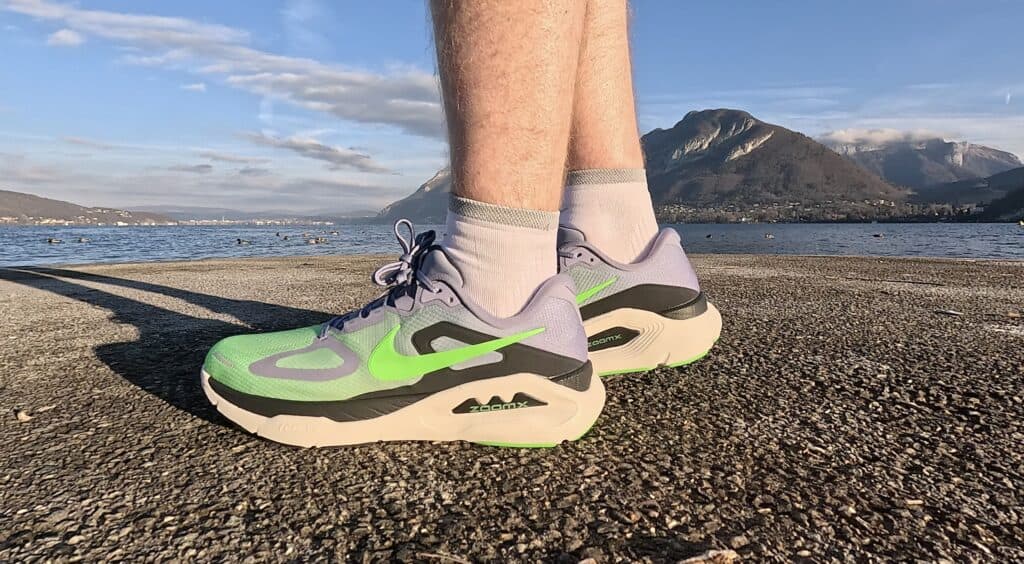
Rather than using a traditional medial post or rigid heel clip, the Structure Plus relies on a midfoot support system and smart geometry.
Key stability features include:
- Lateral heel stability (excellent for mild supinators)
- Internal sidewalls closer to the heel rather than midfoot
- Wide sole flare, especially through the forefoot
- Broad platform to keep the foot centred throughout gait
This creates a modern, guidance-based form of stability rather than aggressive correction.
However, this also defines who the shoe is not for:
- If you need direct arch pressure, this won’t give it
- If you like shoes that deliberately tilt you outward (e.g. NB 860), this isn’t that either
Support here is subtle and centred, not intrusive.
Ride & Geometry: Smooth Start, Flat Middle
Nike has improved the geometry compared to the Structure 26:
- A better heel bevel makes initial contact smoother
- Comfort is excellent at heel strike for both walking and running
- The forefoot is very flexible, despite not having an aggressive rocker
This flexibility makes the shoe a good option if you have:
- Sensitivity around the ball of the foot
- Big toe joint discomfort
- A preference for natural toe-off rather than a stiff rocker
Where it struggles is the midfoot transition. Similar to the Structure 26, the shoe can feel a bit flat and slightly sluggish as you move from midfoot into toe-off. You don’t flow through the gait cycle as smoothly as you do in shoes with a more pronounced rocker.
A more aggressive forefoot rocker in future versions would be a major improvement.
Check the latest prices on Amazon below:

Upper & Fit: Comfortable, Not Premium
The upper uses a new engineered mesh that’s thin and breathable, though not especially premium-feeling for the price point.
Fit notes:
- True to size in length
- Standard-width toe box
- Well-padded tongue
- Extra cushioning around the heel collar
The heel counter is flexible, which is great if you’re sensitive around the back of the heel or deal with issues like Haglund’s deformity.
That extra padding contributes to comfort—but also adds to the overall weight.
Walking & Lifestyle Use: Where It Shines
As a walking and lifestyle shoe, the Nike Structure Plus is excellent.
- Soft but controlled underfoot
- Comfortable heel strike
- Easy, forgiving forefoot push-off
- Wide base adds confidence at slow speeds
- Plenty of colour options for casual wear
It works very well for:
- Long walks
- Everyday wear
- Standing and moving for extended periods
One caveat: the 10 mm drop combined with a very flexible forefoot can increase forefoot pressure if you stand completely still for long periods. If you have forefoot sensitivity, that’s something to consider.
Running Performance: Comfortable but Limited
Running is where the compromises show.
This is not an uptempo trainer:
- Too heavy for faster workouts
- Not ideal for speed sessions or progression runs
Where it performs well:
- Easy runs
- Recovery runs
- Runners who want stability with a softer, bouncier feel
Compared to other stability shoes:
- More springy than the ASICS Gel-Kayano 32
- Less plush than the HOKA Gaviota 5
- Lacks the strong medial guidance of traditional max-stability models
The midfoot flatness limits how smoothly you transition at pace, which ultimately caps its running versatility.
Final Verdict: Who Is the Nike Structure Plus For?
The Nike Structure Plus is an improvement over the Structure 26 and a genuinely interesting take on max stability.
Buy it if:
- You want a comfortable lifestyle shoe with guidance features
- You walk a lot and want something softer than most stability shoes
- You run easy miles and prefer a bouncier feel underfoot
- You like subtle, non-intrusive stability
Skip it if:
- You want a lightweight or uptempo stability trainer
- You need strong medial arch support
- You prefer a more aggressive rocker for running
With a bit less weight and a smoother midfoot-to-forefoot transition, this could become one of the most versatile stability shoes on the market. For now, it works best as a walking-first, easy-run stability shoe rather than a performance-focused trainer, which is why it features in our guide to the best Nike walking shoes.