The Hoka Bondi 9 and the Hoka Gaviota 6 are two of the most popular shoes in the Hoka range.
At first glance, they look quite similar. They both have a high level of cushioning, a thick midsole, a broad base of support, and that classic Hoka rocker shape.
But once you put them on, they feel very different.
The Bondi 9 is the softer, more cushioned, neutral option. The Gaviota 6 is the firmer, more stable, wider-fitting option. So while both can work well for walking, standing, and easy running, the right choice depends on your foot type and what you need from the shoe.
Cushioning: Bondi 9 is softer, Gaviota 6 is firmer
The Bondi 9 has more cushioning overall.
It has around 43mm of cushioning under the heel and 38mm under the forefoot, giving it a 5mm drop. The Gaviota 6 has a little less, with around 39mm under the heel and 33mm under the forefoot, giving it a 6mm drop.
That difference is noticeable, especially under the forefoot.
The Bondi 9 uses a supercritical foam, which gives it a softer, more cushioned feel than the previous Bondi 8. When your heel hits the ground, you sink into the shoe slightly, giving it that pillow-like feeling that many people want from a max cushion walking shoe.
The Gaviota 6 uses Hoka’s classic CMEVA foam, and this version feels firmer than the Gaviota 5. If you liked the soft, sinking feeling of the Gaviota 5, the Gaviota 6 may feel quite different. It is still comfortable, but it has a firmer and more stable feel underneath your foot.
Stability: Gaviota 6 gives more support
This is one of the biggest differences between the two shoes.
The Bondi 9 is a neutral shoe. It has a very wide base, large sidewalls around the heel, and some sole flare in the forefoot, so it still feels stable for a neutral max cushion shoe. But it is not designed as a true stability shoe.
The Gaviota 6 is.
It has Hoka’s H-Frame stability system, which runs along both sides of the midsole and across the middle of the shoe. The idea is to keep your foot centred as you move, rather than pushing aggressively into the arch.
That makes it a more modern type of stability shoe. It does not feel like old-school arch support, but it gives you more control if your foot tends to roll inwards or if you need a more secure platform.
So if you just want comfort, the Bondi 9 is hard to beat. But if you want comfort with more support, the Gaviota 6 is the better option.
Check the latest prices on Amazon:
Fit: Gaviota 6 has a wider toe box
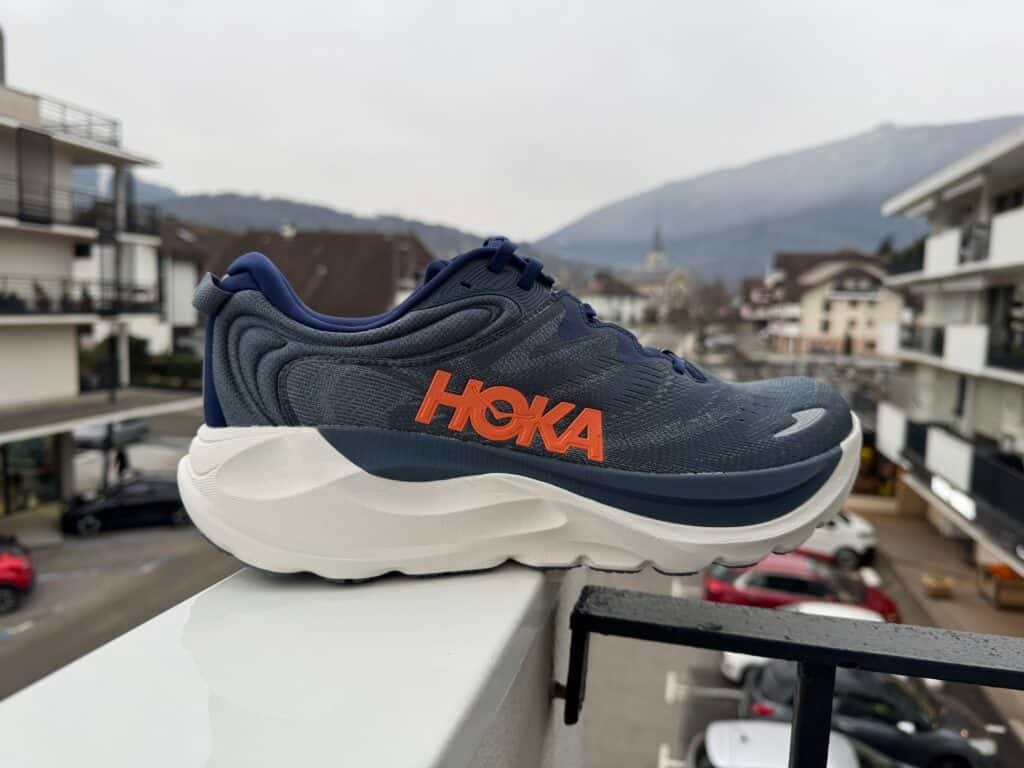
The Bondi 9 actually has a better toe box than many Hoka shoes. Hoka shoes can sometimes feel narrow and tapered at the front, but the Bondi 9 has a more normal-fitting toe box, with a snug midfoot and secure heel lockdown.
The heel is also well-padded, and there is a groove at the back of the shoe. That can be helpful if you have sensitivity around the back of the heel or irritation around a Haglund’s deformity.
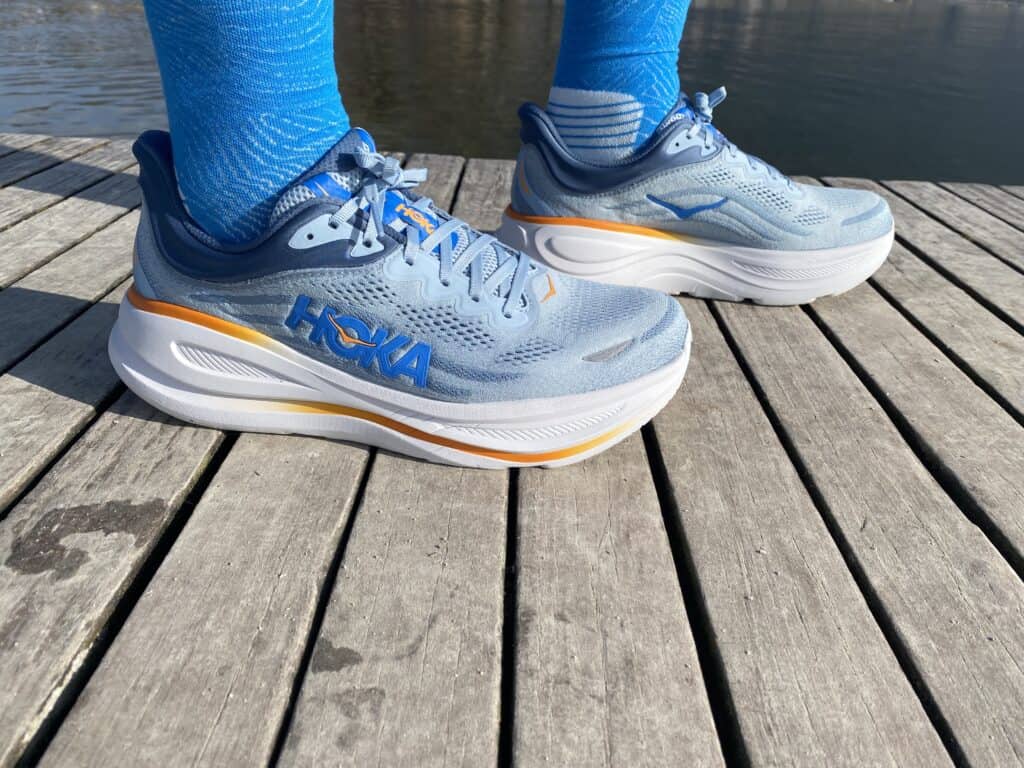
The Gaviota 6 is different because it has one of the widest toe boxes in the Hoka range.
In my opinion, the Gaviota 5 and Gaviota 6 are among the only true wide-fitting shoes in Hoka’s current line-up. You get more room around the forefoot and toes, but still a secure fit through the midfoot and heel.
Neither shoe is perfect if you have a very high-volume or high-arched foot, because the midfoot can feel a little low. But for width at the front of the foot, the Gaviota 6 is the better choice.
Walking and standing: both are excellent
For walking and standing all day, both shoes do a very good job.
The Bondi 9 is the shoe I would choose if you want maximum comfort and a softer feel underfoot. It works well if you are on your feet all day, walking long distances, or just want a very cushioned daily shoe.
The Gaviota 6 is better if you need more stability, have a wider forefoot, or prefer a firmer platform. It still has plenty of cushioning, but it feels more controlled than the Bondi 9.
So the simple version is:
Choose the Bondi 9 if you want soft, cushioned, all-day comfort.
Choose the Gaviota 6 if you want cushioning with extra stability and a wider toe box.
Check the latest prices on Amazon:
Running: Bondi 9 for recovery, Gaviota 6 for stability
For running, they can both work, but they suit slightly different people.
The Bondi 9 feels like a classic recovery shoe. It is soft, cushioned, and comfortable for easy-paced runs. It is not a shoe I would personally choose for marathon training or faster running because it is a little heavy, but for easy 5k, 10k, or 15k runs, it works well.
The Gaviota 6 feels firmer and more stable. It is also slightly lighter, coming in around 283g compared with approximately 297g for the Bondi 9 in a men’s US size 9.
Because of the H-Frame, the Gaviota 6 feels more rigid and controlled. Your foot does not feel like it is moving from side to side as much, which can be useful if you need more support when running.
Foot conditions: which is better?
Both shoes can work well for plantar fasciitis because they have plenty of cushioning and protection under the heel.
The Gaviota 6 is the better option if you need more pronation control or if you have a flatter foot and want more support. It is also very stiff and wide through the forefoot, which can be helpful for big toe joint pain, hallux rigidus, or Morton’s neuroma.
The Bondi 9 is also stiff enough to help with some big toe joint issues, but it has slightly more flex than the Gaviota 6 and less room in the toe box. So for Morton’s neuroma or forefoot width issues, I would usually lean more towards the Gaviota 6.
Final verdict: Bondi 9 or Gaviota 6?
The Bondi 9 and Gaviota 6 are both excellent shoes, but they are built for slightly different people.
The Bondi 9 is best if you want a soft, cushioned, neutral shoe for walking, standing, recovery runs, and all-day comfort.
The Gaviota 6 is best if you want a firmer, more stable shoe with a wider toe box and more support for overpronation, flat feet, or forefoot issues. We review all of Hoka’s walking shoes annually.