The ASICS GT-2000 15 is here, and while it doesn’t look dramatically different from the GT-2000 14, I actually think this is a much more significant update than it first appears.
I bought this pair myself and have spent the last couple of weeks using it for both walking and running, so in this review I’m going to break down what’s changed, how it performs, whether it’s worth upgrading from the GT-2000 14, and how it compares to the HOKA Arahi 9 and New Balance 860 v15.
ASICS GT-2000 15 Specs
The GT-2000 15 now has 38mm of cushioning under the heel and 30mm under the forefoot, giving you an 8mm drop.
That’s 2mm more cushioning at both ends of the shoe compared to the GT-2000 14.
My US size 12 comes in at 305g, so despite adding more cushioning, ASICS has actually managed to reduce the weight by around 6g.
That might not sound like a huge amount, but I think it’s important because we’re seeing a lot of stability shoes become bigger, heavier and more max cushioned.
The GT-2000 15 goes in the opposite direction.
You’re getting more cushioning without making the shoe feel bulky underneath your foot.
Cushioning and Ride
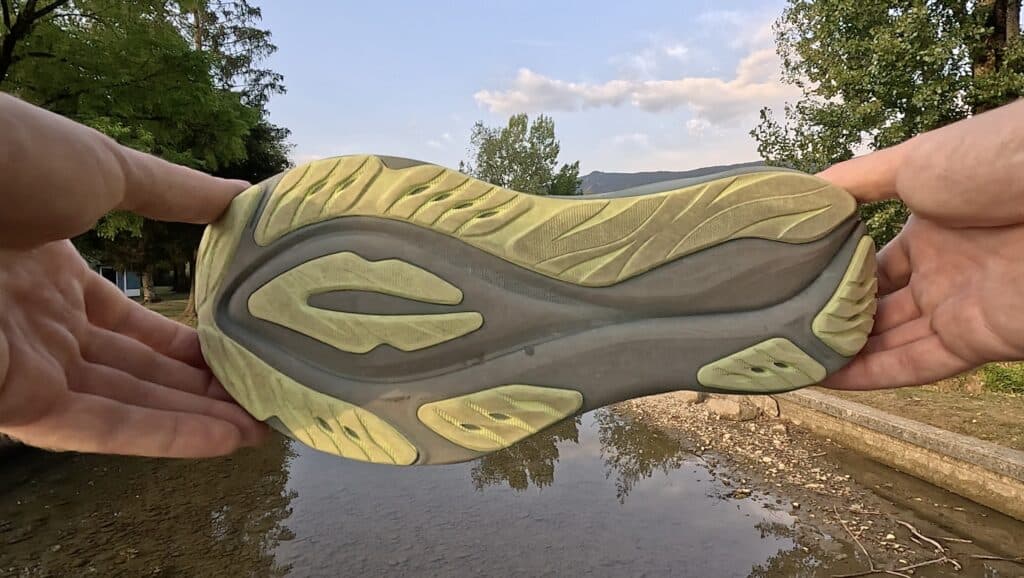
The cushioning is FF Blast Max, and towards the back of the shoe ASICS has added a softer version of PureGEL in the heel.
Then towards the front, there’s what ASICS calls its trampoline outsole pod, designed to improve the amount of energy return you get through toe-off.
I think you can feel both of these changes quite clearly compared to the 14.
The heel is noticeably softer and bouncier.
There’s more compression when you initially hit the ground, which makes heel striking feel more comfortable.
The GT-2000 14 wasn’t an uncomfortable shoe, but it had a relatively firm sensation through the heel.
This isn’t Novablast levels of softness or bounce, but it’s definitely an improvement.
Check the latest prices on Amazon below:
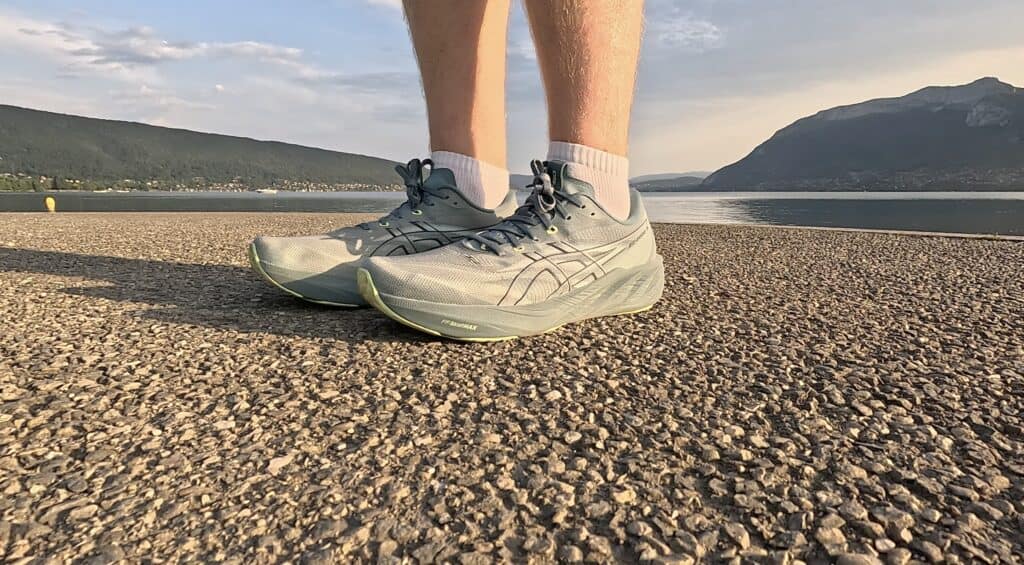
The Forefoot Rocker Is Much Better
For me, this is probably one of the biggest upgrades.
The GT-2000 15 has a more aggressive forefoot rocker and slightly more toe spring, but there’s still a reasonable amount of flexibility through the front of the shoe.
That combination works really nicely.
The shoe doesn’t feel excessively stiff, but the geometry encourages you to roll forward through your toes.
Compared directly to the GT-2000 14, I think the transition from the back of the shoe to the front is considerably smoother.
It makes a noticeable difference for both walking and running.
Stability and Support
ASICS has kept the same general 3D Guidance System rather than completely overhauling the stability setup.
You’ve got a broad platform underneath the foot, plenty of sole flare where the cushioning extends wider than where your foot actually sits, larger sidewalls around the heel, and a rigid heel counter.
All of those features work together to increase the amount of contact you have with the ground and control how your foot moves within the shoe.
However, there’s one characteristic that I noticed in the GT-2000 14 that is still present here.
There seems to be slightly denser cushioning towards the inside of the shoe compared to the outside.
When you’re standing in the shoe, and particularly when you start walking, you can feel a slight sensation that your foot is being tilted outwards.
For somebody who wants additional pronation control without having a big intrusive arch support pressing into the middle of the foot, that can work really well.
However, if you have a history of rolling your ankle outwards, or you simply don’t enjoy shoes that feel like they’re pushing you slightly laterally, I would definitely try these before buying them.
Fit and Upper
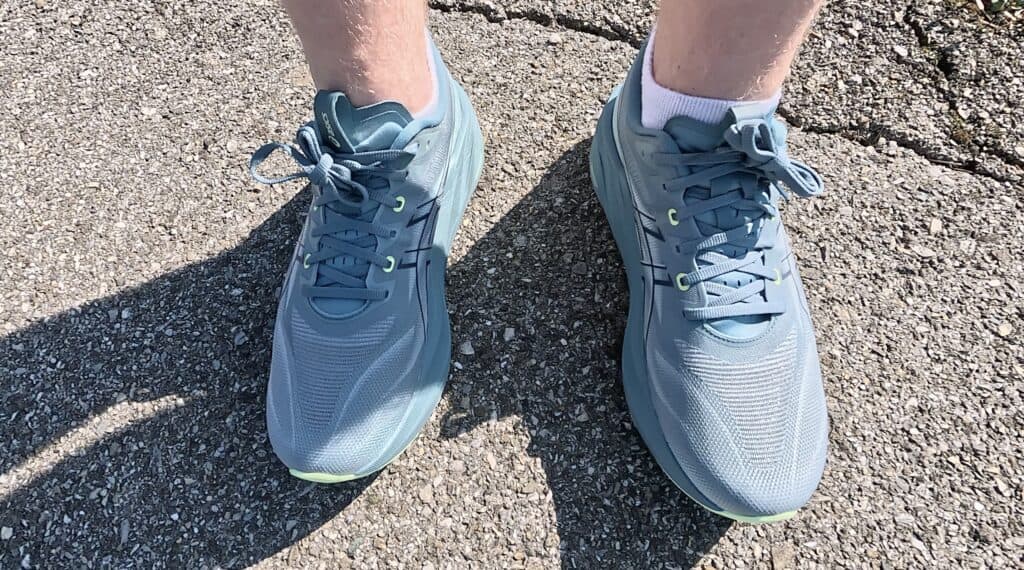
Moving on top of the shoe, there’s a new engineered woven upper.
It’s relatively lightweight, reasonably breathable and has a little bit of stretch to it.
Overall, I think it gives you a fairly classic ASICS fit.
It’s true to size in length for me, with a slightly tapered toe box.
ASICS does offer narrow, wide and extra-wide versions, so there are options if you need more or less space.
The midfoot lockdown is good and there’s plenty of cushioning around the heel cup.
Underneath that padding, there’s also a rigid heel counter, which adds another element of support around the back of the ankle.
Overall, I’ve got very few complaints about the upper.
My main criticism is still the toe box.
ASICS has massively improved the shape of some of its trail shoes, and I’d like to see the road shoes follow the same direction.
Check the latest prices on Amazon below:
ASICS GT-2000 15 for Walking
For walking, I think the GT-2000 15 is a clear improvement over the previous version.
You’ve got more cushioning underneath the foot without making the shoe feel excessively heavy.
The softer heel makes initial contact more comfortable, but you’re not losing the stability that makes the GT-2000 popular in the first place.
Then through the forefoot, you’ve got a small amount of natural movement combined with the increased toe spring and more curved rocker geometry.
That makes the shoe feel considerably smoother over longer distances.
I also think it works well if you’re combining standing and walking throughout the day because you still have that broad, stable platform underneath the foot.
The main thing I’d keep in mind for prolonged standing is that slight medial tilt.
And if you have significant big toe mobility issues, there are other shoes with a stiffer forefoot that may work better.
ASICS GT-2000 15 for Running
Running is where I think the GT-2000 15 separates itself from a lot of other stability shoes.
A lot of modern stability shoes have turned into big max-cushioned cruisers.
They’re comfortable and protective, but they’re also heavy, and you don’t really want to do much more than easy running in them.
The GT-2000 15 feels different.
The heel has enough compression and bounce to make easy runs comfortable, but the lower weight and more aggressive forefoot rocker mean you can actually pick up the pace.
It’s not a dedicated tempo shoe, but it feels considerably quicker and more nimble than most stability shoes.
Other than something like the Saucony Omni, there aren’t many stability shoes I’d rather choose if I wanted one pair that could handle easy miles, steady running and some slightly quicker efforts.
That versatility is probably one of the GT-2000 15’s biggest strengths.
ASICS GT-2000 15 vs GT-2000 14
If you’re trying to decide between the GT-2000 15 and GT-2000 14, I think the 15 wins pretty comfortably.
You’re getting more cushioning underneath the foot.
The heel feels softer and bouncier.
The shoe transitions better because of the more aggressive forefoot rocker and increased toe spring.
And despite having more cushioning, it actually weighs slightly less.
The GT-2000 14 hasn’t suddenly become a bad shoe.
If you can find it heavily discounted, it still makes a lot of sense.
But purely in terms of how enjoyable the shoe is to walk and run in, I think the GT-2000 15 is a definite improvement.
Check the latest prices on Amazon below:
ASICS GT-2000 15 vs HOKA Arahi 9
The HOKA Arahi 9 is probably one of the most natural competitors to the GT-2000 15.
It has 39mm of cushioning underneath the heel and 31mm underneath the forefoot, also giving you an 8mm drop.
However, the ride feels quite different.
The Arahi 9 uses dual-density CMEVA cushioning alongside HOKA’s enhanced H-Frame.
It feels bouncier and more structured overall.
You sink into the heel slightly more and there’s a bit more bounce underneath the foot.
The Arahi also has a nice forefoot rocker, but for me it doesn’t feel quite as lively when you start increasing the pace.
The GT-2000 15 feels lighter, a little firmer through the heel and more responsive overall.
One area where I prefer the Arahi 9 is the upper.
The toe box is considerably better than what we saw in the Arahi 8 and gives you more accommodation around the forefoot.
So, if you want a bouncier, structured stability shoe primarily for easier running, walking and standing, I think the Arahi 9 is a really good option.
If you want something lighter, quicker and more versatile for running, I’d take the GT-2000 15.Check the latest prices on Amazon below:
ASICS GT-2000 15 vs New Balance 860 v15
The New Balance 860 v15 is another obvious competitor, but again it feels very different.
The 860 v15 has 43mm of cushioning underneath the heel and 35mm underneath the forefoot.
That gives you considerably more cushioning and protection compared to the GT-2000 15.
It’s also a much heavier shoe.
New Balance uses its Stability Plane system, with firmer cushioning positioned underneath the medial side of the shoe.
Of these three shoes, I probably notice that medial support most prominently in the 860.
The 860 is also considerably stiffer through the forefoot.
It uses a rocker to help you transition over that stiffness, whereas the GT-2000 allows more natural movement through the front of the shoe.
That creates some clear differences in terms of who they’re best suited for.
If you have something like hallux rigidus and you’re trying to reduce how much movement is required through the big toe joint, the stiffer forefoot of the 860 can be useful.
It’s also considerably more spacious.
You’ve got more width and volume around the toe box, so if you have a broader foot, bunions or simply prefer plenty of room around the forefoot, I’d probably lean towards the 860 v15.
For walking and standing, the 860 probably gives you the most protection of the three.
For running, though, the GT-2000 separates itself again.
The 860 is very much a cruiser.
It’s comfortable, protective and stable, and I think it’s considerably more enjoyable to run in than the previous version.
But there’s still a lot of shoe underneath your foot.
For longer, slower mileage or if you just want maximum protection, I’d probably choose the 860.
If you want something lighter, quicker and more nimble, I’d take the GT-2000 15.
Check the latest prices on Amazon below:
Who Should Buy the ASICS GT-2000 15?
I think the GT-2000 15 makes the most sense if you want a stability shoe that doesn’t feel like a big, heavy stability shoe.
It gives you a broad and supportive platform, but you’re still getting a reasonably lightweight and versatile ride.
I think it works particularly well for people who want one shoe for a mixture of walking and running, or runners who need additional stability but still want something capable of picking up the pace.
I’d be a little more cautious if you have a history of rolling your ankle outwards, don’t like the sensation of a medial wedge, or need a particularly spacious toe box.
ASICS GT-2000 15 Review: Final Verdict
Overall, I think ASICS has done a really good job with the GT-2000 15.
On paper, some of the changes look relatively small.
In practice, they make quite a significant difference.
The extra cushioning and softer heel make it more comfortable, while the more aggressive rocker makes the shoe considerably smoother through the forefoot.
And crucially, ASICS has managed to make those changes without turning it into another heavy max-cushioned stability shoe.
For me, it’s one of the strongest all-round stability shoes on the market at the moment.
If you already have the GT-2000 14 and you’re happy with it, you don’t necessarily need to rush out and replace it.
But if you’re deciding between the two, I’d comfortably choose the GT-2000 15.
And if you’re comparing it to the Arahi 9 or 860 v15, the decision really comes down to what you want from the shoe.
Choose the Arahi 9 if you want a softer, bouncier and more structured ride.
Choose the 860 v15 if you want maximum cushioning, forefoot stiffness and more space around the toes.
Choose the GT-2000 15 if you want the lightest, quickest and most versatile option of the three.